Sunday, May 22, 2016
The fabulous Ann Leary talks about THE CHILDREN, the weirdness of weddings, being reclusive, writing, her movie (!) and so much more
I first met Ann Leary at Japonica restaurant in Union Square. We came for lunch and stayed for the stories we were telling--FOUR HOURS OF THEM. I had the best time ever. So besides loving Ann, I love her work and I'm thrilled to be celebrating THE CHILDREN. It already has a starred Kirkus, which is notoriously difficult to get, (They call it "deeply satisfying...with shards of dark humor..) and she's going to be reading this Tuesday at the Barnes and Noble on East 86th! (I will be at the JBC auditions otherwise I would be there).
She's the author of An Innocent, A Broad; Scenes From a Marriage, and The Good House, and all are wonderful. And so is she.
Thanks, Ann for gracing my blog!
Of course, I want to know, what sparked this novel? What drove you to write it? And how did it change from what you originally envisioned to what it became?
I wanted to write about the often-complicated relationships that develop between siblings, stepsiblings and parents in blended families. My parents divorced in the 1970s. I don’t know if it’s statistically true, but I think the people of my parent’s generation engaged in a sort of unprecedented mass uncoupling. By the time I got to college, I had very few friends whose parents weren’t divorced. So I knew many who shared my experience of straddling two nests, but having no real home after a divorce. After my parents remarried, my mother lived in her husband’s house. When I came home from college, I was a guest there. My father lived in another state, with his wife – a woman I barely knew, and her young children. There, too, I was a guest. My parents had divided loyalties between their new spouses, their biological children and their stepchildren. This was difficult for everybody.
I remember visiting my father when I was a teen and being surprised at the person he was in his new family, which was very different than the one he had been in our family. His stepsons were younger than we were, and they really loved my dad. They thought he was hilarious and teased him good-naturedly. They had goofy nicknames for him, and he took no offense. He got such a kick out of them. My siblings and I - his biological kids - had a much more fraught, uneasy, formal relationship with him. At the same time, my younger sister, who lived at home with my mother and stepfather for a while, had a very good relationship with our stepfather. They just adored each other; they had a fun, easy-going rapport. He seemed to be a little less relaxed with his own kids. Now, as an adult, I recognize that the fathers probably had some guilt about their own kids and worried about the type of people they would become. They didn’t have this burden with their stepchildren; they were able to just enjoy them for who they were. If the stepchildren grew up to become sociopaths, addicts or career criminals, it wasn’t really a reflection on them. Their own children, though, had better watch their step, they had the same last name, the same genes. In some ways this worked out, as we all turned out okay. Not one of us is a career criminal. And now, because of death and divorce, I’m no longer related to any of the people who were once my stepsiblings. But I do see them on occasion and it’s so interesting to me the way that we all experienced our families in such different ways. I know this is also true of families whose parents stayed married. Everyone who grows up with a sibling, experiences the family from a unique perspective, but we each tend to assume that our siblings experienced the family in exactly the same way we did.
I think that the setting in any novel is as important as the characters. The place has to be as authentic as the characters, so I like to write about places where I’ve lived and the characters are drawn from the types of people who live in those places. My last novel, THE GOOD HOUSE, was set on Boston’s north shore, where I lived as a teen. THE CHILDREN is set in northwestern Connecticut, which is still New England, but a very different New England. The novel is set on a lake similar to one near our home, where we’ve lived for the past eighteen years. There is a particular breed of New England WASP – the good old-fashioned, blue-blooded Yankee – that just never ceases to fascinate me and there are still quite a few around here. So I decided that the parents in THE CHILDREN, Whit and Joan Whitman, would be this type.
And they are a “type.” The type who have many millions in old stock-holdings, but drive ancient, rusty station wagons and delight in clipping coupons out of the Sunday papers to save a few cents. They often live in rambling “cottages” (with 8 or more bedrooms and staff quarters) that were built by their ancestors, but have been rather let go over the years. The kitchens have failing appliances that were installed in the 1970s. There’s a coffee table in the living room that has deep gouges made by the teeth of a puppy who grew old and died decades ago. You’ll find antique beads that belonged to a flapper aunt in one bedroom, a 1960s lava lamp in another. A macramé plant holder containing a dead fern hangs in the library. These are people who only turn the thermostats up high enough to keep the pipes from freezing and wouldn’t dream of installing central air-conditioning; who thrill at finding a penny on the street; who still bemoan a loan of 12 dollars to a school friend in the 1960s, who – well, why go on? They’re, as I said, a “type.” I really enjoyed immersing myself in the eccentric Whitman/Maynard family while writing this book.
Being sort of reclusive myself, I loved the portrait of Charlotte and her other Internet life. Where did that come from? Are you reclusive at all? (You don't seem that way)
That’s funny, because you don’t seem reclusive, either, which is one of the things I was interested in exploring in this book. I think of you as a good friend that I’ve known for years. Yet, we’ve only met in real life a few times. We’re mostly online friends. I was interested in exploring the relatively new social dynamic that has been created by the Internet. We all think we see each other all the time. If somebody is a total recluse, as Charlotte is, most people are entirely unaware of it, because they see her on social media or chat with her online.
Charlotte’s reclusiveness did come partially from my own experiences. My social life has, in recent years, been conducted primarily on Facebook and Twitter. I write every day, so I’m on the computer a lot. I spend most of my time in Connecticut on our property. We live in a small town with no shops, one cozy little restaurant. We still don’t have cell-service in our area. I spend most of my time at home with my husband and our animals, which, for me, is heaven. I do like to see people in our community and in New York, but in recent years, when I go to social events, I’ve found that it sometimes takes me days to recover. I tend to overcompensate for my social anxiety by being very “on” when I see people face-to-face. Afterwards, I worry that what I considered “on,” might have been perceived by others as a state of full-blown mania. So, I ruminate a lot after socializing. “Why did I say that?” What must she have thought?” “Was that woman backing away from me because she didn’t get how funny my story about my noncancerous mole was? Or is she just a backer-upper type?” “Was that man offended when I made the joke about all the catheter commercials? What if he uses one? Why did I have to say that?”
You know, that kind of thing. It’s exhausting.
Charlotte’s reclusiveness is slightly more pathological; she really has become a shut-in. And she has an alternate persona on the Internet. Online, she’s married and has a wildly successful mommy blog. She’s snarky and fun and has loads of friends. In real life, she’s a childless 29-year-old who spends most of her time in the attic of her mother’s home. There was a trauma that happened to the children in this family and the novel is about how each carries the emotional scars caused by that incident, even now, when they are adults. They never talk about the thing that was so disruptive. Because, they’re WASPs, they never really talk about unpleasant things at all, so everything seems very pleasant, until it becomes very unpleasant.
Why do you think weddings always bring out secrets, surprise, and sometimes the worst in people?
You know, I really don’t like weddings. I’m told that my own wedding was wonderful but I was in sort of a dissociative state throughout. It made me very anxious – not the part about being married, but the whole ceremony and reception. Everybody was staring at us. This was a relatively casual wedding in my mother’s backyard, but I was a nervous wreck. Part of it was just my social anxiety, but part of it was the discord created by my parents divorce, which had happened many years prior. There were still hurt feelings, anger between the parents about money. But everybody had to look so happy.
In THE CHILDREN, I drew on my own experiences to a certain extent. A wedding is supposed to be a time of happiness and celebration. If there are old spites, anger and rifts in the family, of course they will start making their way to the surface, because everybody is forced to participate in the planning. Because it’s supposed to be a happy time, there is this strained civility in the days and weeks leading up to the wedding. You’re picking out flowers, but everybody’s shooting daggers.
So, your last genius novel, The Good House is going to be a movie with Robert DeNiro and Meryl Streep—with Michael Cunningham adapting the book into a script. Do you wake up every morning and have to reconvince yourself that this is indeed true? And are you getting a cameo?
You’re so sweet! Yes, that was very exciting when they announced the two leads! It’s still in development, they’re ironing out the script. I’ve heard they might start production this spring, but we shall see. There are so many moving parts involved in filmmaking. That’s why I love writing books, you really don’t have to worry that the main character has two other projects that they’ve committed to.
What’s obsessing you now and why?
Where do I begin? I’m very obsessive. Fortunately, I am currently obsessed with this new novel that I’m writing. I can’t say much about it except that it’s loosely based on my grandmother and her real-life involvement with a very disturbing and corrupt organization in the 1920s.
What question didn’t I ask that I should have?
You forgot to ask when we can meet up for sushi again! X
Tuesday, May 17, 2016
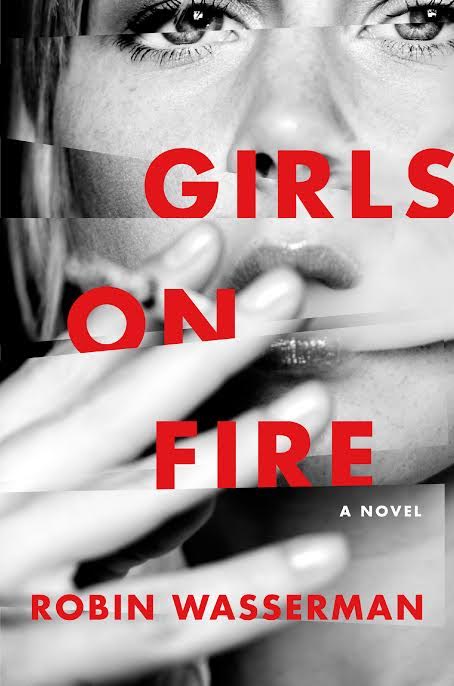
Violence. Girl Friendship. Damning Beauty. The amazing Robin Wasserman talks about her adult debut, GIRLS ON FIRE, obsessions, split brain writing, and so much more
Every once in a while, you read a book and then you realize you are actually gripping the pages in admiration. That's how I felt reading Robin Wasserman's extraordinary novel GIRLS ON FIRE. (Don't forget to check out her website for tour info and an excerpt!) You want to hear her speak!) Don't believe me or all the buzz surrounding Robin and her book? Take a gander below:
One of the most anticipated reads of 2016 according to Flavorwire and BookRiot
A Publishers Lunch Buzz Book
A BookPage Woman to Watch in 2016
A Top 2016 Debut to watch from Elle UK, The Irish times, and Red Online,
“A dark, propulsive fever-dream of youth and friendship….all I could do was keep reading, relentlessly enthralled by the heat-seeking missile of Robin Wasserman’s fearless imagination.” –Leslie Jamison, author of The Empathy Exams
“A book so wonderful, so terrible, so nightmarishly compelling that I hardly knew what to say when I finished reading it. Has a title ever been truer? The reader comes away singed.” —Kelly Link
“Like lightning in a bottle…seldom do you find a novel that so transports you to the dark, febrile terrain of adolescence….[Girls on Fire is a] captivating, terrifying novel, and one you won’t forget.” –Megan Abbott, author of The Fever
“Wasserman’s prose is a spell cast over the reader, shockingly full of the terror of truth….Wasserman is a brilliant writer, and Girls on Fire is a gorgeous gift of a novel.” —Laura Kasischke, author of Mind of Winter
"Next we have Robin Wasserman's Girls on Fire, which, with its narrative witchcraft, conjures up the ghost of the decade to full effect."--Flavorwire's 50 Signs of Hope for Culture in 2016
"Robin Wasserman’s novel Girls on Fire will utterly terrify you — in the best way possible."--Buzzfeed's 19 Incredible New Books You Need to Read this Spring
Robin's work has also appeared in Tin House, The New York Times, TheAtlantic.com, and The LA Review of Books. her YA books s include The Waking Dark, The Book of Blood and Shadow, and the Seven Deadly Sins series, which was adapted into a television miniseries. AND, you can read an excerpt of Girls on Fire here.
I'm so jazzed to have Robin here! Thank you, thank you, Robin
I always feel that writers are somehow haunted into writing a particular novel. Were you? And if so, what was your ghost?
I love this theory, and a nagging ghost makes as much sense as any other explanation of where ideas come from. I’m haunted by the spectres of friends past: A long string of wild girls who I imagined would be, if not my soulmate, then my salvation, escape from a life of mundane desperation. My first best friend, who chose me when we were eight and ditched me cold when we were twelve, set the pattern: She was exuberant, stubborn, willful, bossy, and seemed—at least to my shy, rule-following eye—exhilaratingly herself. I spent my childhood and teen years chasing after this feeling, the joy and relief of being attached to someone who seemed prepared to set the world on fire, the permission it granted me to be both more and less myself. All these years later, I’ve been fascinated by the dynamics of that kind of friendship: Why was I so eager to play sidekick? And, more mystifyingly, what did all those wild girls get from letting me tag along? What was it about me that I still couldn’t see for myself? Those are the questions that first sparked Girls on Fire, and I guess you could say the novel is my effort to finally exorcise the ghost.
This is your first novel for adults, yet so many YA novels are read by adults, too, that I'm often perplexed at the difference. Did it feel different for you writing Girls on Fire? Did anything surprise you about it?
With my YA books, I never sat down at the computer thinking explicitly about writing for teenagers, or about audience at all (which may speak more to my narcissism than my craft, I suppose). I just wrote the stories I wanted to tell, in the language that seemed right. Girls on Fire is set in the early ‘90s, the time period of my own teen years, which lends it a more retrospective feel than I’ve allowed myself in YA—and I’ll admit that it was deeply pleasurable to revel in the culture and aesthetic of the grunge eras (not to mention doing the “research,” eg re-watching Reality Bites and Singles more times than I’ll admit here.) But I tackled the initial draft the same way I had any other book, ignoring audience in favor of story, just getting the characters and the language down on the page without worrying about who would publish it or how. I think the shift to “adult” fiction, whatever that might mean, happened in later drafts, as I allowed myself to expand to expand the story in directions that I wouldn’t necessarily have been inclined to take in a YA novel. (Caveat: That’s not to say I couldn’t have, or that other YA writers haven’t, just that for me, this was the excuse I needed to attack the story in an unfamiliar way.)
The biggest difference involved allowing myself to write more about the adult characters, specifically the mothers. While not a huge part of the book, page-count-wise, these women—and the question of girlhood transformed into motherhood, of the generation gap and efforts to cross it—became a really fundamental element for me. I started thinking of the novel as not just a passionate friendship romance between three girls, but an exploration of girlhood itself. It turned out that after a decade of writing for teenagers, I had quite a bit I desperately wanted to say about them, and I poured all of that into this book. It feels like putting the period on a very, very long sentence.
Violence, loneliness, repair, secrets--that is all part of girlhood friendships--and I think they somehow mark us through the rest of our lives. Do you agree?
Speaking as someone who, as an adult, has written about almost nothing but the violence, loneliness, repair, and secrets of girlhood friendship, I’d better agree! I will admit, I used to be much more confident about the “rest of our lives” thing, but I’ve discovered that as I make my way through my thirties, my teen years are starting to feel further away than ever before. I mean, obviously they are, chronologically—but they also feel emotionally less relevant, as I finally get it through my thick head that the image I formed of myself at age 13 (awkward, weird, blunt, frizzy-haired, booksmart but people-clueless) isn’t necessarily accurate anymore. I feel less beholden to the mistakes I made and the things that happened to me, less inclined to say, “I’m the kind of girl who _______” based on choices I haven’t made for the last fifteen years.
That said, whoever I am now and whoever I become, it’s because of those early days: The people who hurt me, the people I loved, the dreams I had for myself. As evidenced by the fact that I’m clearly still holding a grudge against the friend who dumped me in sixth grade! I don’t really remember what I made for dinner last night, but I remember viscerally where I was on the playground when I overheard her telling someone I wasn’t her best friend—I’m never going to forget how that felt, and for better and worse, some part of me is always going to be that girl, feeling abandoned and alone.
Tell us what kind of writer you are. Do you map things out? Follow your pesky muse? Do you have routines and charms that urge you along? Your language is so diamond gorgeous that I wonder which comes first for you, the voice or the story? Or do they occur at the same time!
First off, thank you so much. “Diamond gorgeous” is such a lovely compliment I’m tempted to tattoo it across my forehead. (I’m trying to be less self-deprecating, and that would definitely be a good start…)
If I have a muse, he or she should speak up, because we’ve got some things to discuss. Specifically, why he or she isn’t a little speedier on the genius-idea-manufacturing front. Let’s step it up, shall we? Why should I be the one doing all the work?
For me, coming up with ideas is brute force labor, and it’s partly because the story always comes first. I’ve long wished I could be one of those writers who just starts out with an image, or the sense of a character, and wanders her way leisurely down the narrative’s garden path. But for whatever reason, that’s never worked for me. I have a million documents on my computer with a first paragraph or first sentence—some phrasing or voice that’s captured me and seems violently promising—but that’s it. A few sentences, the ghost of a piece, and nothing more. I never return to them, I’m never forced to push past the beginning, because they’re just words that were rattling around in my head. To keep going, I need them to be attached to a story, something I feel the impetus to tell.
I have kind of a split-brained process—on one side, I’ll start gravitating toward a particular kind of character, while on the other side, I’ll start circling around a nebulous kind of plot, and eventually—hopefully—there’s some alchemical spark when the two collide, and that’s when I know I’ve got something. The voice comes last. I don’t outline fiction, but I do spend a lot of time thinking through characters and making notes on scenes I want to write and emotional throughlines I want to explore, etc, before I actually sit down to page one. (Semi-related: I’m very good at procrastination.) That’s when I start worrying about the voice—it’s a little superstitious, but I don’t like typing the first sentence until I’ve already perfected it in my head, and, along with it, the sound of the story. So by the time I start writing for real, the voice tends to be fully formed.
What's obsessing you now and why?
One of the things I wanted to explore in Girls on Fire was the concept of obsession, largely because it’s something I’ve never thought myself particularly capable of. I’m too much of a dilettante. But here’s a sample of what’s crowding my brain right now:
The Longform podcast (I’ve always been too nervous to do much journalism myself; the podcast lets me live vicariously). The dark net. Moral panics about female adolescent sexuality. The Hamilton soundtrack. The democratic primary. Paris. The subprime mortgage crisis. Books about 1970s ballet. Girls. The neuroscience and philosophy of mental imagery. Creationist dinosaur hunters. Child stars. The photo-taking impairment effect. Nostalgia. Toast.
What question didn't I ask that I should have?
Here’s a ridiculously un-original suggestion: What am I reading right now? I usually hate this question, because either my mind suddenly goes blank or I’m reading something thoroughly underwhelming—or I expend way too much energy trying to come up with an answer that will somehow encompass everything about my literary soul (or, less purely, boost whatever friend of mine has a new book out). But on this particular day, I just happen to have finished the most remarkable book, and I desperately want the rest of the world to know about it: The Association of Small Bombs, by Karan Mahajan. This novel, which plays out the consequences of a marketplace explosion for both the victims and the perpetrators—although that’s such a reductive synopsis it doesn’t even begin to get at what Mahajan is doing—starts out really good and gets better. Then it gets astounding. This is one of those books that makes me want to be more ambitious in my own writing—that makes me remember exactly what a powerful story can do. READ IT.
Wednesday, May 11, 2016
Claudia Casper talks about THE MERCY JOURNALS, writing, the wreckage of the world and so much more. Plus, read an excerpt!
THE MERCY JOURNALS by Claudia Casper (Arsenal Pulp Press, May 10, 2016)
©2016 by Claudia Casper
First, an excerpt:
___________________________________
On October 15, 2071,
two Moleskine
journals were found
wrapped in shredded
plastic inside a
yellow dry box in a
clearing on the east
coast of Vancouver
Island near Desolation
Sound. They
were watermarked,
mildewed, and ragged
but legible, though
the script was wildly
erratic. Human remains of an adult
male were unearthed
nearby along with
a shovel and a 9mm
pistol. Also found
with the human remains
were those of
a cougar. The journals are reproduced
in their entirety
here, with only minor
copy-editing changes
for ease of reading.
____________________________________
JOURNAL
ONE
March 9, 2047 |
My name is Allen Levy Quincy. Age 58.
Born May 6,
1989. Resident of
Canton Number 3, formerly Seattle,
Administrative Department of Cascadia.
This document,
which may replace any will and tes-
tament I have made in
the past, is the only intentional act
of memory I have committed since the year 2029. I do not
write because I am ill or because I leave much behind. I
own a hot plate, three goldfish, my mobile, my Callebaut
light, my Beretta M9, the furniture in this apartment, and
a small library of eleven books.
Addictive, right? Claudia Casper is the author of the novels The Reconstruction and The Continuation of Love by Other Means, which was short-listed for the Ethel Wilson BC Book Prize Her writing has appeared in the Globe and Mail, the Vancouver Sun, Geist, Event, Best Canadian Short Stories(Oberon), the anthology Dropped Threads: What We Aren’t Told (Vintage), edited by Carol Shields and Marjorie Anderson and Canadian Content. She is writing the screenplay for a 3D feature film France/Canada coproduction of The Reconstruction. Her work has been published in Canada, the US, the UK, and Germany. With Anne Giardini, Casper conceived the Carol Shields Labyrinth, an interactive online labyrinth that honours Shields’s life. I'm delighted to host Claudia here. Thank you, Claudia!
I always imagine that an author is haunted by
something that propels the novel. What sparked yours?
There were two first sparks for this novel, or at least I
can’t remember which came first. One was reading a newspaper story about the Canadian
General, Romeo Dallaire, who headed up the U.N. peacekeeping mission to Rwanda
just before the genocide, being found black-out drunk on a park bench in Hull,
Quebec. It turned out he was suicidal and haunted by what he’d witnessed there,
and by his helplessness to stop it. He became one of the first spokesmen for
soldiers suffering from PTSD, as well as a passionate advocate for humanitarian
intervention (he asked: “are some people more human than others?”). PTSD seemed
such a fundamentally human response to horror. My main character, Allen Quincy,
is partly inspired by Gen. Dallaire, though he is much lower ranking, less
idealistic, and the PTSD upends his life more thoroughly.
The second spark came from my family history. My father was
German, fourteen when World War II ended. His father was a general in the
German army and his mother, who separated from his father during the war, told
my father after the war that she was Jewish. I grew up with an imaginative foot
on both sides. When 9/11 happened, and with the conflicts it has spawned since,
as well as with the Rwandan genocide, I had a strong reaction to the self-righteous
rhetoric used by the media and by politicians, that posited that genocidal
behavior and other wartime atrocities was behavior that only existed in other
cultures, other ethnicities, other nations (the Germans, Africans, Arabs), when
I felt strongly that it was behavior common to all human beings in specific
contexts. I won’t say any more because I don’t want to give away plot surprises.
The Mercy Journals isn’t just about Mercy, the character,
but it’s also very much about the quality of mercy and how we can find it in a
world that is mostly wreckage. Can you talk about that please?
Mercy is the opposite of the law, of just punishment. It’s
that area in between an act and a consequence that is filled with fellow
feeling, with love. Mercy is something we all want. Mercy is true free choice,
it’s unmechanical, it’s like a breeze, it simply appears, it cannot be ordered
up. Mercy transcends the laws of nature and the bargain and barter of transactions,
and yet it’s as wild and unpredictable as nature, otherwise it’s just
forgiveness. No one wants to ever live in a world without mercy. That would be
a very dark place indeed.
The future landscape you’ve created is so chilling because it
is really a “it can happen here” scenario. What was your research like, and did you get
more and more uneasy the more you learned?
Because climate change has had such a pressing reality for
me for years, I don’t feel I got more uneasy the more I learned. Ever since I
read Tolstoy’s War and Peace, which so skillfully delineates how impossible it
is for humans to control history, that there are too many moving parts and
complex interactions for any one person or group of people to control, I have
had an acceptance that we are largely on an unpredictable biological ride as a
species. That being said, I don’t view that ride as hopeless, or unmitigatedly
negative. We are a brilliant mix of beauty and horror, significantly weighted
on the beauty side. We bond deeply and loyally, we feel sacred wonder for life,
we feel gratitude for creation, we are social creatures who survive through
co-operation, but we are also murderous, impulsive, insecure and terrified.
Ironically though, the fact that we can’t control history
does not mean we aren’t still responsible for it. We should try and limit the
consumption of fossil fuels, and avert the catastrophes that I am convinced
will follow if we don’t. We could reduce energy consumption with no pain and
even some gain in quality of life. We may be complacent in the west because we
assume hotter and poorer countries will take the brunt, but that is blinkered
thinking. A 2003 Pentagon report concluded climate change would lead to a
future where “once again, warfare would define human life.” Not worth it.
Quincy, your hero, is desperate to forget, yet he writes all
his memories down, believing that he can turn fact into fiction. I find this
incredibly interesting because of a time when I was critically ill and given
memory blockers, so I could not work through what had happened because I
couldn’t remember it. It was only when I made it up through fiction that I was
able to heal. Do you believe that the brain knows the difference between memory
and what really happened?
I don’t think the brain does know the difference between
memory and event reliably. New brain research shows that the same areas light
up in reading about an experience and remembering it, as actually having it.
Fascinating. In a way all memory involves a form of narrative we create about
our experiences. I believe, for example, for many of us, the memories from our
childhood have either been triggered by photographs or stories other people
have told about us. Very few are direct memories of sensations. Perhaps the
memories of how it feels to first master something, like swimming, or riding a
bike, or throwing a baseball are the most based in real experience. Memories,
like dreams, are always infused with emotion, but who can tell if it’s the
actual emotion we were feeling at the time? I have always been fascinated with
how much of who we are, our identity, is made out of memory, depends on memory for
its existence. What we worry most about with regards to death, after our actual
non-existence, is not being remembered. Is being erased from the planet. My dog
died recently and one of the things that made it so particularly painful was
that I couldn’t communicate to her that I would always remember her. Memory was
not something we could share.
What’s obsessing you now and why?
I am obsessing now about the power structures involved in
helping behavior. About the entanglements of ego, status, power-over and
power-under, involved in assuming the role of helping someone. As the oldest
child and only singleton of both my parents’ union, with two half siblings from
my mother’s second marriage, and seven from my father’s subsequent liaisons, I
am perfectly set up to try and consolidate my tenuous feeling of belonging with
helping behavior. Self-examination and realizing that help is not always,
ironically, helpful spur this new obsession.
What question didn’t I ask that I should have?
What computer game am I addicted to.
Wednesday, May 4, 2016
The difficulties of writing a masterwork: The sublime Jennifer Haigh talks about Heat and Light, nearly abandoning the novel, writing, and so much more
I so love Jennifer Haigh's work that I'd have her on the blog every week if I could. Her latest novel, HEAT AND LIFE is ambitious, profound, and absolutely dazzling. Richard Price calls it, "smart, sharp, hyperprecise, and near incantatory in its momentum." Ha Jin dubs it "a thrilling page turner" and Richard Ford calls it "Brilliant beginning to end." But that praise could be said about all of her novels: FAITH, THE CONDITION, BAKER TOWERS and MRS. KIMBLE, winner of the PEN/Hemingway Award for debut fiction. Her short story collection NEWS FROM HEAVEN won the Massachusetts Book Award and the PEN New England Award in Fiction.
The thing I love the most about this interview (beside the fact that I get to do it) is the honesty about the process. She's said that writing HEAT AND LIGHT nearly killed her, that she abandoned it but couldn't let go, until it finally began to coalesce. I'm so jazzed and honored to host Jennifer here. Jennifer, thank you for everything.
What was the generation of this book—what sparked you into to wanting to write about it?
I grew up in western Pennsylvania and still have family there, so the gas drilling phenomenon was on my radar from the very beginning. When I started writing HEAT AND LIGHT, the drilling boom was going full force, and the national debate over fracking was raging. Josh Fox’s documentary Gasland had just come out, and environmental activists were campaigning for a moratorium on fracking in New York State – a measure that eventually passed. Among my peers -- writer friends in Boston or New York -- there was overwhelming consensus that fracking was an environmental catastrophe in the making. So when I went back to Pennsylvania for a visit and an old friend told me his parents had signed a gas lease, I was stunned. From his perspective, this was the opportunity of a lifetime; why would anybody say no? I was struck by the contrast between how people in Pennsylvania viewed fracking, and the attitude in New York State. The difference is that Pennsylvania has always been an energy state. The first oil well in the world was drilled there. The Three Mile Island nuclear disaster happened there. Coal companies dominated the economy for a hundred years. All that history has shaped the culture in profound ways, and I explore that in HEAT AND LIGHT.
How difficult a process was it to write this novel? How did you write this? Did the process differ from your previous books?
For me, the process changes every time. I approach each book as a unique engineering problem. Unlike a poem, which can succeed or fail entirely on aesthetic terms, a novel is a machine – a one-of-a-kind contraption I am designing, building, testing and re-testing, so that by the time it lands in a reader’s hands, all he has to do is turn the key and the machine will come to life and start moving on its own.
More than any other book I’ve written, this one has a lot of moving parts. There are so many strands to this story, so much history brought to bear. When I’m writing, I don’t think about plot so much as causality – how each event has consequences that lead to more consequences. As I was writing HEAT AND LIGHT, I kept thinking about that old board game, Mousetrap -- the game Wesley is playing in front of the television as they watch the news about Three Mile Island. The object of the game is to build a complicated mouse trap out of unlikely parts: a drainpipe, a bathtub, a seesaw and so on. As a kid I was obsessed with that game, that moment when you turn the crank and kick off the whole intricate chain reaction, which ends with the plastic cage sliding down the pole to trap the mouse. Writing HEAT AND LIGHT felt very much like that. It’s a story that gathers momentum. I love making sentences and take great pains to write to write good ones – but in the end, this is a novel, not a poem. When you turn the key, you want the thing to move.
Did anything about this novel surprise you?
Everything about this novel surprised me. For the first two years I had no idea what I was writing. The shape of the book changed monthly, sometimes weekly. What started out as a story about fracking became a love story, a deconstruction of what went wrong at Three Mile Island, an exploration of what it’s like to be transgender in a very small town, the rise and fall of a ruthless CEO. It took me years to understand how all these pieces fit together, the interconnectedness of everything.
As I wrote, I was surprised to discover how much of the story had to do with addiction, that perverse human compulsion to poison ourselves in much the way heavy industry poisons the land. Like many small towns, Bakerton has a thriving bar culture, which is out in the open; and a methamphetamine problem, which nobody talks about. After the coal mines closed, addiction became the most successful local industry. When Dick Devlin was laid off from the mines, he opened a tavern. His older son is a corrections officer in a prison full of drug offenders, and the younger one is a counselor at a methadone clinic – an entire family employed, directly or indirectly, by addiction.
Writing this novel nearly killed you. Could you elaborate?
HEAT AND LIGHT is a big book, an intricate book. It seems to me now that every thought I’ve ever had is in this book. From the very beginning, I felt overmatched by the complexity of the story. Twice I abandoned it entirely and started writing something else, but I found I couldn’t leave it alone. At several points in the writing process, I hit a point of complete cognitive paralysis. It’s exactly the way I felt studying calculus in high school, like I was mixing concrete with an eggbeater, asking my brain to think in a way it wasn’t designed to do.
I love the way you express the world as it was, as it is now, and as it might have been too. Can you talk about this?
We all live simultaneously in the past, present and future. Most of us can’t go ten minutes without recalling the past or fantasizing about the future, all while going about our business in the here and now. To be psychologically true, fictional characters must reflect that complexity. All the characters in HEAT AND LIGHT are haunted, to one degree or another, by the past, by broken promises and missed opportunities and dreams that failed to materialize. And in a way, I’m haunted too: I’ve written two other books set in Bakerton, so I’m keenly aware of the town’s history, its glory days as a bustling coal town and its long painful slide into poverty after the mines closed. There is a collective memory of boom and bust, an ancestral memory even the young people carry, a peculiar nostalgia for times they aren’t old enough to remember. As one of the characters reflects, “The town is all aftermath.”
What’s obsessing you now and why?
Like everybody, I am riveted by the upcoming election, a window into all that is best and worst in the American character: our cynicism and idealism, our fears and bigotries, our short attention span and hunger for entertainment, our deep-seated and mostly unconscious sexism, our national delusions of grandeur and authentic capacity for heroism. There’s a novel in there somewhere.
What question didn’t I ask that I should have?
I’m glad you didn’t ask it, but one question I always get has to do with research – how much I did, and what kind, and how it shaped the novel. I hate that question, because I can’t seem to answer it without disappointing. The person asking the question is usually an aspiring writer, and she doesn’t want to hear that research doesn’t lead to a novel, that all the art happens long after the research is done. To write HEAT AND LIGHT, I spent years learning about fracking, about nuclear energy, what it’s like to work on a drill rig. I learned about organic dairy farming, heroin addiction, EST, the Iranian Revolution, thyroid cancer, female shot-putters, strip mining, disciplinary procedures in Pennsylvania state prisons. But when it came time to start writing, I made it all up. Research is useful in constructing the skeleton of a character’s life. The rest is empathy – an imaginative leap into another human being, his interior weather, how it feels to walk through life in his body, to live in his house and make love to his wife and drive his car and wear his clothes. No amount or kind of research can tell you that.
Monday, May 2, 2016
Amber Brock talks about A FINE IMITATION, type A planning, Neil Gaiman, history, writing and so much more
I'm partial to debuts, so I'm especially delighted to be hosting Amber Brock and her fine first novel, A FINE IMITATION. Just take a look at the high praise:
“There’s never a dull moment in this debut novel centered on an intriguing and tightly woven story line. Vera’s struggles are highly relatable, and the anguish she feels will resonate with countless readers. This surefire hit is certain to be beloved by fans of Beatriz Williams’s Along the Infinite Sea and Anton DiSclafani’s The After Party.”
– Library Journal, starred
"An absorbing tale of art, deception, romance, and forbidden desire."
– Publishers Weekly
Thank you so, so much, Amber for coming on the blog!
What was haunting you that drove you to write this novel?
A Fine Imitation started with a dream I had about a woman in a high-rise and her relationship with an artist painting a mural in her building. Still, even before I began to write, I knew I wanted to create more than just a good love story (though, of course, a good love story is nothing to sneeze at—I’m forever a fan of books that feature well-crafted romantic tension). But for me, because I teach at an all-girls’ school, I often found myself thinking of my students as I began to tease out important moments in my manuscript’s plot. I always ask my students to consider how the social conventions of an era shape a person’s opportunities and choices. In telling this particular story, I wanted to make some of the challenges that women faced in the early twentieth century come alive for my girls and for others. Even though my main character, Vera, is privileged in a lot of ways, she’s still very much restricted by what was expected of women in those decades, especially in her college years.
How does it feel to be a successful debut author? And does this make it harder or easier to write your next novel?
Being a debut author is overwhelming, amazing, scary, fantastic…a rush of emotion. I’ve dreamed about holding my own book in my hands since I was twelve years old, so the idea that my novel is going out into the world is still sinking in somewhat. I’ve found, interestingly, that starting the next novel has been similar to the start of the other unpublished novels I’ve written. There’s always some insecurity, but since my focus is always on completing the work (rather than the publishing stage), I’m dealing more with the specific challenges of the novel I’m writing. In some ways, it’s easier for me to tackle the writing when I’ve let go of the goal of publishing.
So much of your fine novel is about who we are and who we are meant to be. Can you talk about this, please?
We make a lot of decisions about who we want to be when we’re young, and early adulthood can feel like a “finish line” in a lot of ways. House? Check. Job? Check? Family? Check. We’re ticking off boxes on a list instead of considering what kind of life we truly want to pursue. Too often we let others choose our path for us, whether that’s because of parental pressure, societal pressure, or our own desire to create the sort of life that we imagine will earn us the admiration of people we respect and love. This is Vera’s struggle—she’s made all the “right” choices, but she’s not being true to herself. Once she recognizes that, she begins to re-evaluate everything.
A Fine Imitation is set in the roaring twenties, so I always want to know, what surprised you in the research? Did any of the things you discovered derail your plot temporarily, or open it up?
I always find myself researching the strangest things when I’m working on a novel. For one scene in A Fine Imitation, I needed to know how long a 1920s elevator would have taken to travel about twenty floors. I ended up learning more about the evolution of elevators than I ever expected. That’s one reason I love writing historical fiction in the Internet age—there are so many people who are experts in such fun subjects, and Google allows me to find their collected information in a way that wouldn’t have been possible only a few decades ago.
Running across an actual program from a 1923 exhibit at the Metropolitan Museum of Art was one particularly nice surprise. That discovery led to the inclusion of a painting (Portrait of Giovanna Tornabuoni) that added weight and meaning to the scene it’s in and eventually colored the way art is discussed in the novel.
What kind of writer are you? Do you have rituals? Do you map things out?
I am a Type-A planner by nature, so no one who knows me is shocked to discover that I have lists, plans, charts, and chapter outlines. I always handwrite those materials, so I have notebooks full of scribbles.
I usually prefer to draft in the summer. I’m a teacher, so that time is marginally less busy. But inspiration arrives whenever she’s ready, so at times I’m writing in the evenings or on weekends (or between classes!). And, as with so many writers, my best ideas come in those moments when I can’t write them down—in the shower, driving my car, and just as I’m about to fall asleep. I’ve honed my memory so I can capture as many of those ideas as possible!
What’s obsessing you now and why?
Now and always—history. When I can steal a moment, I’m reading The Year of Lear by James Shapiro. Since I teach British literature, I’m always looking to learn more about Shakespeare’s work and the British canon as a whole.
I’m also researching the early 1950s in New York and Miami, and I continue to find it fascinating how seemingly minor events can continue to affect society long after most people have forgotten them.
What question didn't I ask that I should have?
What is the most surprising thing that influenced you as you were writing this novel?
I don’t think too many people would immediately connect my novel with Neil Gaiman and Terry Prachett’s cult classic Good Omens, but that book (which I love and teach) changed the way I think about how a novel’s conclusion should work. As I read the first time, I kept thinking, “There’s no way they can pull this off.” That was the last time I underestimated them. They set up an impossible choice between one potential outcome and another, then concluded with an outcome I never saw coming. When I found I’d given Vera a similar impossible choice, thinking of Good Omens freed me to consider other endings for her.
Karan Bajaj talks about The Yoga of Max's Discontent, being a striving yogi, Wall Street verses enlightenment, and so much more
-->
I'm honored to have Karan Bajaj ihere to talk about his wonderful new novel, The Yoga of Max's Discontent. He's an Indian American author of three contemporary Indian novels, Keep Off the Grass (2008), Johnny Gone Down (2010) and The Seeker (2015). Bajaj's first novel, Keep Off the Grass, which became a bestseller with more than 70,000 copies sold in the year of release, was a semi-finalist for the Amazon Breakthrough Novel Award and was longlisted for the Indiaplaza Golden Quill Award. Together his novels have sold more than 200,000 copies in India.
I always think that a writer is sparked to write a particular novel. So what sparked you to write The Yoga of Max’s Discontent?
For me, two things have to come together to embark on a
novel—entertainment and meaning. I’d been playing around with the idea of
writing about a journey through secret India for years but it became a deeper,
three-dimensional reality when my mother died from cancer.
My questions about the nature of human suffering became more
urgent for me to answer. So in 2013, my wife and I set forth as monks with a
metaphorical begging bowl, going from Europe to India by road with no
possessions, then learning yoga and meditation in a remote ashram in the
Himalayas.
Both the adventure through secret India—hidden yoga ashrams,
surreal night markets, remote Himalayan caves—and my own transformation through
the journey became the impetus for The Yoga of Max’s Discontent.
You call yourself a
“striving yogi”, and you spent five years on that path—that’s so fascinating I
have to ask you to elaborate. Are you
still striving?
Indeed, very much striving! A yogi is on the journey to
dissolve himself or herself completely, to become just a vessel for his work to
express itself. I slip and fall often but I like to think I’m working everyday
towards that ideal. Whether in my writing or my corporate career, I just try to
act without attaching myself to the outcome. Like a tree that just grows and
bears fruit because that it’s innate tendency, I try to work and write to
express my innate tendency without thinking of whether my books will change the
world or establish my platform or sell a lot.
I love the message of the novel, seen through the eyes of Max, who gives up Wall Street for a quest for enlightenment. Do you think America will ever prize the spiritual over the material? Or even consider it to be a worthy search? (I hope so.)
We have this idea in India that life’s journey is like the
flight of an eagle. First, you flap your wings high, as high as you can flap
them, growing with experiences in the world. Then, you gracefully bring the
wings down, go within and complete your journey. So there’s a role for both and
I think you’re seeing that a little in America now. You’re seeing folks who’ve
realized that it’s monotonous to run after external experiences, be it houses,
cars, travel etc. infinitely, and they’re choosing to become more silent
through yoga, meditation, or their spiritual practices. So indeed, I think a
societal shift is occurring.
What kind of writer are you? Do you map things out or have them channeled through you or a little bit of both?
Over the last decade, my writing style has been a little bit
parallel to my life. I follow what I
call a 4,1,4 model:
4 Years: Extreme goal-directed living—working at my
corporate job, disciplined reading/writing/researching etc.
1 Year: Complete slack—take a sabbatical where I travel
without a goal, write when I want to, meditate, work in an orphanage, basically
allowing myself the space to just be and discover facets of myself without the
constant hankering to become.
4 Years: Return to corporate/goal-directed life.
…and so on.
I’ve done three cycles of this and traveled, deepened my
writing, and learned yoga and meditation in my sabbaticals. In that sense, I
think writing is a reflection of my life. For four years, I’m very outline-driven,
then I completely let go. I think this balance of tight and slack is helping me
produce work consistently yet have a hint of transcendence in it.
What’s obsessing you
now and why?
I’m thinking a lot right now about the Axial Age, that unique
period of ten centuries between 10 B.C and 0 A.D. when Confucius, Buddha,
Jesus, Plato, all sprouted in the world with the same mystical insight into the
nature of reality without having any connection with each other at all. I think
it had something to do with society reaching a point of relative prosperity
when it had progressed enough to not have to compete for resources yet hadn’t
progressed enough to create too many technological and entertainment
distractions. That space for contemplation may have been crucial to get a
direct insight into the nature of reality.
I’m reflecting on all this because I’m wondering how to
construct a life that allows me that space for mystic contemplation and not get
sucked into the cult of modern productivity.
What question didn’t
I ask that I should have?
I guess a little about my writing history since I don’t have
the usual credentials—MFA’s, New Yorker writing stints, or other creative
writing pedigrees. I’m an engineer-MBA from India and wrote two novels in India
on the side with HarperCollins, both of which became #1 bestsellers in India
and were optioned into films. I resisted the impulse to publish them in the US
despite publishing offers because I didn’t think I had anything new to add to
the conversation with the books in the West—they were very specific to the
Indian cultural context. This is the first time I feel I’ve written something
which will give pause to readers in this part of the West and I’m eager for
their feedback!
Karan Bajaj is the
author of THE YOGA OF MAX’S DISCONTENT (Riverhead, May 3rd’ 2016).
Get your free gifts worth $299 including your free meditation video course,
yoga flow course, and Quit Sugar in 7 days guide, when you order the book at www.karanbajaj.com/yogamax (150 Spots Only!).
1940s and 50s American, the beginning of the women's rights movement, atomic bombs and birds--Elizabeth Church talks about her incandescent debut, The Atomic Weight of Love
I'm always partial to novels that come from my beloved publisher, Algonquin, and this one, Elizabeth Church's The Atomic Weight of Love, had me reading into the wee hours of the morning. Brilliantly written, incredibly alive, Elizabeth has captured a woman whose love of science helped her find herself. It's really a genius novel.
Elizabeth practiced law for more than thirty years and her short story "Skin Deep" won first prize in the 2001 fiction contest from Literal latte. She has amazing taste in earrings, too, by the way, and I'm deliriously happy to have her here. Thank you, Elizabeth!
I know (according to Stephen King), you aren’t supposed to ask writers where a book sparks, but I also know, that as a writer, that there usually is an answer, and it usually has to do with what is haunting the writer at the moment. What sparked your novel?
A middle-aged contemplation of my history, that of my mother, that of the women I knew growing up in Los Alamos. Somewhat to my surprise, the book turned out to be a way for me better to understand my mother, our differences -- what led us to pitched battle for so many years and what ultimately let us find peace with each other. Meridian forms a bridge between our two generations.
What was the research like? What surprised you? And did the research make you a bird watcher, or were you one already?
I was already a bird watcher (more of behavior than species identification), a person steeped in the sciences, a person who has a nearly constant internal dialogue that goes something like: "Hunh. I wonder why X. And how does THAT work, function, come into being? I wish I knew more physics/biology/chemistry." Once I decided to focus on crows, I devoured several books on the topic -- and relished learning all sorts of obscure facts, in particular about their phenomenal intelligence. These birds can recognize individual faces -- and pass that knowledge on to their young!
Writing about the landscape closest to my heart, that of northern New Mexico, led me to move back to Los Alamos after an absence of over forty years. I wanted to return while I could still physically manage to hike the trails through the mountains, along beautiful cliffs, and amongst wildlife (including cougars!). My decision to move back to Los Alamos after such a long hiatus came as a bit of a surprise.
The crow journals change, as Meri changes, and become more personal and more intimate. The more she opens up, the more she suffers--and the more it’s worth it. Can you talk about this?
What an entirely lovely, astute question! Over time, Meridian allows herself to become more complete, to permit her emotions, her spirit, to emerge more fully. Her intellect had always overpowered the rest of her being, tamping down her artistic side (her painting), and her sensitivity. A wise friend once told me that we only grow through pain -- never through joy or simple contentment. Pain teaches us what we value, and it can teach us who we are (or strive to be). I believe that we build resilience, true strength, only through suffering. And yes, I set about to make Meridian suffer. I set about to find out what it would take to make her move, to take charge of her life.
There’s a lot of discussion today about whether women can really “have it all.” Certainly, they couldn’t in Meri’s time, during the 50s and 60s, when women gave up their dreams so their husbands could live theirs. Yet, in the end, Meri crafts an enviable life, but there still is a cost to her. Do you think it will ever be possible to get beyond that cost?
I don't think we get beyond the incalculable costs of unconscious self-abnegation, martyrdom or self sacrifice (no matter how greatly those attributes -- particularly in women -- might be applauded by society). What Meridian does, what we all have to do, is take the clay remaining and fashion it into something beautiful, meaningful. In that way we conquer, we "win" -- even if we still carry a history of loss. I also think we owe it to younger generations of women to remind them of progress made, and the need for constant vigilance to prevent backsliding, the insidious creep of misogyny. Let's take a moment and ponder the current election atmosphere in this country, shall we?
What kind of writer are you? Do you map everything out or just follow your computer?
I have to do some mapping before I begin, or I wouldn't begin -- wouldn't know where to begin. I let the character(s) begin forming in my head for weeks and months ahead of time. Once I begin writing, I am so deeply, thoroughly living the characters that they take on a life of their own -- some are born without my say-so; some act in ways I would not have predicted. The characters largely determine action and plot, and I may have to let go of my initial plans for the story line. When I'm writing well, I have very little control over what's going on. Hours pass in a flash. I am a mere conduit, a mere stenographer.
So much of this book is really about the moral choices we make--and the cost of those choices. The scientists at Los Alamos thought they were making the world safer, while the Viet Nam war protestors marked them as warmongers. Do you think we can ever know the ramifications of a historical moment while it is happening?
I think, sometimes, we can have a sense of ramifications at the time an event takes place. Certainly, Oppenheimer and others knew the bomb would change the world in profound ways. Could they predict all of the ways the bomb might change the world? Could they begin to foretell how it would populate our dreams and alter our very psyches? No. But could they anticipate changes in balances of power, the dire need to keep the knowledge they'd amassed from politicians' absolute control, to prevent misuse of the formidable power of atomic warfare? Yes. After all, the world had just seen what Hitler and his ilk wrought; it had seen survivors of the Bataan Death March.
With respect to questions of morality implied in your query -- I have come to believe that context is an all-powerful determinative factor. For me, a solid knowledge of the context in which the bomb was created and used is essential when interpreting its morality.
I loved how each chapter begins with fascinating facts about birds. Did you always know that that would be the structure? And what did you learn about crows that fascinated you the most?
Long before I began to conceive of the novel, to have Meridian living in my head, a friend sent me a list of bird groupings. I was entranced by the sheer poetry of the "scientific" names for bird groups. I kept that list for years -- thinking how wonderful it would be to write a book using those bird group names as chapter titles. And so, they long preceded the nascent stirrings of characters, setting, and plot. They became even more charming when I began to decide which bird group might best tie into the events of a given chapter.
The crow research that most surprised me was that young crows have blue eyes that change to brown. How I'd love to spot a blue-eyed crow!
What’s obsessing you now and why?
My next novel. Feathers of another sort -- those worn by Vegas showgirls in the Sixties. Dean Martin. Elvis. Tom Jones, Dinah Shore, and Sammy Davis Junior. How the illusions created by Vegas contrasted with the real world at the time -- the Civil Rights Movement, Vietnam, hippies. And how events of a childhood might so thoroughly warp, twist, tangle, and mangle both being and perception, that finding love is rendered next to impossible.
What question didn’t I ask that I should have.
Two things: How grateful am I to you for your generous support, how many of us benefit from the leadership you provide? The answer is IMMENSELY GRATEFUL.
Secondly, I suppose you didn't ask me if I could have written this book several decades ago, had I summoned the fortitude to make the sacrifices necessary to change my life so that I could write. Were you to ask me that question, I would have to say that I could not have written this book at any point prior to when I did actually sit down to write it (age 56). I hadn't sufficient wisdom.
Mrs. Wyatt Earp? There really was one and Thelma Adams talks about her wildy west, brilliantly rendered novel about her. Now in PAPERBACK
Love, loss and making history on the page. Thelma Adams tells the astonishing story of Josephine Sarah Marcus Earp, exotic, Jewish, and in love with the notorious Earp.
Adams is a novelist, movie critic, journalists a writer and leading New York-based film critic. Her debut novel Playdate (St. Martin’s Press/Thomas Dunne Books) came out in hardback January 2011, and paperback the following year. She is currently a freelance writer, most recently profiling Diane Keaton, Mark Ruffalo, Julianne Moore, Ethan Hawke and Patricia Clarkson for the New York Observer following three years covering the awards season for Yahoo! Movies. She was the film critic at Us Weekly for eleven years from 2000 to 2011, following six years at the New York Post. She has twice chaired the New York Film Critics Circle. She has written for The New York Times Magazine, O: The Oprah Magazine, The Huffington Post, Marie Claire, More, Interview Magazine, The New York Times, The international Herald Tribune, Cosmopolitan and Self. She has appeared on CNN, E!, NY1, NBC’s TheToday Show, CBS’s The Early Show, OMG! Insider, Fox News Channel, Access Hollywood, Entertainment Tonight, Bravo and VH1.
I'm thrilled to have Thelma here. Thank you, Thelma!
What could be more fascinating than a novel about Mrs. Wyatt Earp? What sparked you to write this extraordinary novel?
A novel can have many origin stories. I saw -- somewhere, somehow, nearly a decade ago -- that Wyatt Earp was buried in a Jewish cemetery (a word I can never spell) in Colma, California. I became obsessed. Was Earp Jewish? No. So why would the famed gunslinger, the hero (or villain) of the Gunfight at the OK Corral be buried in a Jewish cemetery?
The answer was Earp's wife of nearly fifty years: Josephine Sarah Marcus Earp called Josie by some, Sadie by her family. That was the beginning. Here was a knot that I needed to untangle, a question of Jewish identity that intrigued me.
First and foremost I wanted to know who the hell Josie was. Who was this beauty who turned up on a few pages in the many, many books that praised or reviled Wyatt in that 'the man, the myth, the legend' way. Josie did write a memoir that was edited by her descendants, I Married Wyatt Earp. It exists in multiple formats, some truer than others. But all versions are to a certain extent opaque, so far from contemporary memoirs that scratch down to the sticky embarrassing truth like Running with Scissors or Wild.
One goal of Mrs. Earp's memoir was always to restore Wyatt's good name, and by extension Josie's place beside him. Because, in the conventional history of gunfights and border skirmishes, law and order, Republican and Democrat, she only existed at his side on the frontier. And, then, she's often portrayed as a floozy, an actress or dancer, a beautiful opportunist, an exotic, a Jewess. As a historian out of Berkeley, I knew that there were many alternate histories, and the history of women and the poor are not marked by battles won or lost. A social historian has to dig deeper and read between the records in order to discover what these forgotten people were about. Once I heard about Josie, I wanted to dig deeper and discover what made her tick.
One thing I wanted to know was whether Josie really run away from home with dreams of becoming an actress with a travelling H.M.S. Pinafore troupe as her memoir says. Just that one detail seemed fantastic and marvelous because when I read the Gilbert & Sullivan lyrics for an operetta whose heroine is coincidentally named Josephine, I woke up. I realized that this was an era – the early 1880s, nearly two decades after the Civil War -- far more sophisticated culturally and socially than I'd credited it. Like that romantic heroine of the stage, mine ran into the arms of the man she loved – not the one her father (or mother) would have chosen. So this beautiful Jewish girl from a middle class Eastern European family had her own independent narrative running in her head, informed by the popular culture of her day. And she piqued my curiosity: what was it like to look out at this Wild West through Jewish eyes with Jewish values and traditions?
I knew that I could only get close to it through fiction, through imagining what impelled Josie from a good home in San Francisco to the dangers of Apaches and outlaws and scheming politicians in the Arizona territory, in Tombstone. The silver boomtown near the Mexican border couldn't be reached directly by train. It was both a land of opportunity and disaster.
In order to get myself into Josie's head, I channeled the feelings that I had, leaving home at 17 for Berkeley six hundred miles away, a place where I would determine my fate and, if not write poetry then at least live poetically. I had passion and so did Josie – and that's where we connected in the beginning. Josephine quickly discovered that she was no actress or dancer or singer – but she had a talent for drama and sweeping onto the center stage, which put her by Wyatt Earp and into his arms the very year that he fought and survived The Gunfight at the OK Corral.
Josie really came alive for me when I thought: what does it mean to be a Jewish woman in the wider world of events outside the home in a society where gentiles make the rules? How are those qualities that I see in myself – liveliness, intellect, a need for justice, a need to be heard and seen and find a true soul-mate, the weight of guilt and the past, a daddy's girl and a mother's misfortune – manifested in Josie, a woman born in the past but reborn in a novel?
Was writing this second novel different than writing your first?
Writing The Last Woman Standing was very different from Playdate, which began as a screenplay and evolved into a novel of contemporary manners – and which sold first. It contained very little research and channeled my experience of motherhood into a comic situation about a stay-at-home dad that was intended to be a cross between Shampoo and Mr. Mom. In some ways, it was chick lit with a male protagonist, which was not an easy sell. Meanwhile, I had written a very large chunk of thoroughly researched Mrs. Earp when my two children were still young on the hope that I could sell it on a proposal and continue my research and writing while raising my kids. I had shelves and shelves of primary and secondary sources.
To me, Josie's life seemed ripe for a novel – and this was before academic Ann Kirschner's acclaimed nonfiction book about Josephine, Lady at the O.K. Corral, had been published. I was then a film critic at Us Weekly, and without a commitment I could only manage two hundred pages. They were full of details – the size of a carriage and the number of horses pulling it, the style of women's clothing and cowboys' hats – but they lacked a strong storytelling impulse and the overall voice was uneven and, frankly, a little fruity. They also included the perspective of Wyatt Earp's sister-in-law, Allie Earp, a prairie pioneer with a bitter past. Her salty perspective spoke to me but it wasn't until I regained Josephine as a first-person narrator years later, and handed the story entirely to her that the book came alive. It was thanks to my agent Victoria Sanders, who read the initial pages when I pulled them out of a drawer and said in her fabulously blunt and truthful way: great idea, execution not so hot. "Get me three smoking chapters and a proposal and I can sell this," she said. I did -- and she did.
Those fresh chapters (nine rather than three) sacrificed the fascinating frontier story of Allie, but went back to the San Francisco house where Josephine was raised and fleshed out her mother (a key figure in shaping who Josephine was), her father and her siblings. In a completely fictional scene, I seated them at dinner beside the Shabbos candles on the Friday night that Josie departed for Tombstone. When Josie left home in 1880 engaged to the gentile John Harris Behan, who would become the sheriff of Tombstone and a fierce enemy of Wyatt, Josie's mother tore the collar of her best dress and sat shiva. Knowing that fraught relationship, and how earlier generations of my own family had reacted to children who intermarried, grounded the entire book. Josie lived her adventure in Tombstone one thousand miles southeast, but her mother's critical voice remained in her head along with her father's unconditional love.
What surprised you in your research? (And what did you have fun making up?)
I tried to lift the lid on the women in the story and also to weave in a bit of photographic history. The Gunfight at the OK Corral occurred in the vacant lot beside Fly's Photography Gallery, a bustling hub in town. And while C. S. Fly took the famous photo of the victims of that gunfight, it was his wife, Mollie (also a photographer) who ran the studio. She also managed the attached boarding house where the famed "Doc" Holliday lived. Central to the Fly's marriage – which was her second – was their mutual love of photography. All of this I got from research and is relatively straightforward – and could itself become the core of a book. Writing The Last Woman Standing I was always tumbling over tangential stories that seemed to cry out for their own novels.
There are wonderful photographs that have survived from this period – and one controversial risqué portrait of Josie (that has largely been discredited) wearing nothing more than a black net mourning veil. Rather than trying to determine its provenance and validity and enter a rabbit hole of a historical battle, I created a relationship between Mollie and Josie that unfolded in the studio. Their activities wouldn't have been recorded in the newspapers of the day, or the diaries of the local miners and politicians. What if Josie, who was by all accounts the most beautiful woman in Tombstone, became an artist's model for Mollie – as an alternative to selling her flesh as a prostitute? What if?
And as I researched, I discovered a startling connection to the history of art photography. This was the very time that photography was becoming cheaper, easier and more portable while meanwhile more respected as an art form. What I discovered, as I dug into Victorian erotic photography, was that one of my favorite painters, Thomas Eakins, was taking nude pictures at the Pennsylvania Academy of Art in the decade prior to the 1880s. In fact, contemporary to my story, the Academy dismissed Eakins for teaching from life models to a co-ed classroom. When he lifted the loincloth on a male model for a female student to see, he crossed a line.
So, I was enjoying fascinating art history research when I discovered that the famed "Doc" Holliday had studied dentistry in Philadelphia while Eakins was at the Academy. I realized that, as an educated Southerner, Holliday would have likely visited the art studio and been exposed to the latest uses of the technology. He could easily have shared that knowledge with Mollie, his landlady. The historical record seemed to confirm that my fictional direction yielded an insight into Tombstone beyond the facts of gunfights and fringed jackets. There was a rich culture in Tombstone, and a daring one, because in many ways the adventurers that congregated there were unfettered by convention. Because the boomtown was only a few years old at this point, and infused with silver and those attempting to grasp it, there was no inherited wealth or established elders. And while male writers and filmmakers have focused on the women-as-wives-or-whores trope, I tried to figure out how this freedom from societal apron strings could manifest itself among the female figures I encountered.
This inspired, and seemed to validate, a sensual scene where a distraught Josie (who has just left Wyatt's bed before he rode off to lead a dangerous posse) poses for Mollie. I personally, even a century later, would be too ashamed of my bits and pieces to pose nude but here is Josie, her emotions having risen to her skin from recent sex and deep sorrow, getting photographed: "I felt my body relax. My shoulders dropped. I released my neck, stretched the fingers, and then let my free hand fall heavily where my legs intersected. I bent my knees and curved my feet around each other. I heard Mollie behind me, exposing film, changing glass plates, moving the camera closer, changing lenses. As she did this, I relaxed more deeply—not dozing, not forgetting my pain, but suspended in the camera’s eye."
In that climactic moment, I made the leap from research to imagination.
You have profiled megastars like George Clooney, Jessica Chastain and more, and you've covered films and festivals--and been on just about every major TV show there is. What was it like for you to settle in and get solitary writing a novel?
I have always done both – film criticism and poetry. I wrote my first film review for The Daily Cal and my first published poem (possibly my only) appeared in The Berkeley Poetry Review. I struggled for a long time to accept myself as a writer, which was my own fault. I now tell people: if you write, you are a writer. Do not seek accreditation or benediction from others. I received my MFA in fiction from Columbia in 1993, the same year as I got my first professional job as a critic at The New York Post. As a critic, over the years, and as a member and chairperson of the New York Film Critics Circle, I began to travel in celebrity-heavy circles just as celebrity culture really took off. Us Weekly hired me in 2000 when they went from a monthly to a magazine published once a week. And then it started: my immersion in celebrity culture.
I still get speechless in front of certain directors and behave like a cartoon character, although my friends who attend parties with me think I display an incredible sang froid in the presence of bold-faced names. I love talking to people and so doing profiles of Clooney, the most charming man on the planet, or Chastain, a searcher with a big heart, or others that have become friends, has been relatively easy. I don't, however, claim that my heart doesn't beat faster at times, or that I don't fumble when the luncheon conversation stumbles and I'm seated next to Robert DeNiro. My answer is to find the commonality – as I do with my historical characters. I try to bring an honest me – a writer, a mother, someone who has seen many films and read many books – and not approach celebrities slavishly. The truth is that I have something to offer, too, which is authenticity.
I have always been an extrovert who loves solitude. So I relish the long quiet of writing – thinking with my fingers. That mind-fingertip connection: there's nothing like it, the pleasure of rereading and tinkering. I consider writing books like being a marathon runner, I am happiest when I am in training, in a book, capturing that rhythm. I don't long for nightlife, then, or the company of famous people. I write. I read. I watch good TV (the French cop show Spiral or the Scandinavian The Bridge, for example) or movies from my collection. I sit with my cats. I talk to my children. I do yoga, which I find helpful in connecting bigger ideas within my work. I make Ethiopian chicken in the crockpot. Yes. I have a really big crockpot. And, then, when I go to a film festival, or interview someone like Mark Ruffalo or Diane Keaton, I'm coming from a real place. Remember: they are, too.
Which brings me to the question--what kind of writer are you? Do you map things out or do you like to follow the muse?
As a novelist, I have been struggling toward structure for a long time. My first unpublished novel, Girl Empire, was a picaresque. Playdate took place over four days. The Last Woman Standing had tent-pole events: the arrival in Tombstone; the date of the lynching of Johnny-Behind-the-Deuce; The Gunfight at the OK Corral; Josie's exit after assassins attempted to kill Wyatt's brother Virgil and the town became too hot for the Earps and their friends. And, yet, there were big gaps in the narrative: she came to marry Johnny Behan, and she left attached to Wyatt Earp. When and how did that happen? What were those events that did not hit the historical record and how would I shape them to reveal my characters? I am not by nature someone who carefully plots but in this case, since I sold it from a proposal, I did have to map out how the chapters fit together for the table of contents I submitted. That was a good exercise for me. I found that even when I could not see the whole book in my head, I could often see three chapters ahead. And so I approached it as I would a writing schedule, concentrating on three chapters at a time, hitting the tent-pole events, aiming for the final chapter, which I knew before I even wrote my first one. I also follow the muse in that when characters talk, I listen. Sex scenes take on their own heat and you have to get out of the way and let your characters just do it. And I had this one minor character, a brothel owner named Madame Mustache, who just took over the pages she was on: she was a truth teller with ulterior motives and her voice took over whenever she appeared. I would say that whether you map out your chapters, or float forward in time, the muse will always find you. She will leave you, too. And that's when the marathon matters: just showing up at the computer is so much a part of the craft and the art of novel writing.
What's obsessing you now and why?
Right now I'm absolutely obsessed with my next novel, Kosher Nostra. Set in Brooklyn from 1902 to 1935, it is about the little sister of a button-man in Murder, Incorporated: the Jewish subcontractors for the mob that specialized in contract killing. It opens on the night of October 23, 1935 when the Williamsburg Boys Club killed Pretty Amberg and set the body aflame by the Brooklyn Navy Yard with their wives and girlfriends watching.
It is my first attempt at a novel of such scope – three decades in a single life. It's based on a real character that lacks a birth certificate or a notice in the newspaper: my grandmother Thelma Lorber. Her older brother was Abraham "Little Yiddel" Lorber, all of five foot two. These are little lives with big emotional arcs on the schleppy side of Boardwalk Empire. At 19, Uncle Abie stabbed a man for questioning his bravery on 14th Street in broad daylight. That made the newspapers – although it was something I learned in the archives and not from my family.
If I were E. L. Doctorow or William Kennedy, Uncle Abie would be my protagonist. But I want to figure out what it was like for Thelma (who I resemble) the wiseass little sister. She was born in 1902 into hard times and they just got harder. She depended for succor and protection on her beloved older brother Abie, only to see him get pulled into the mob and away from her. Like her sibling, she was a hedonist. But she existed in a stifling culture that didn't permit women to experiment out of wedlock. She married a man who suffered from a deep depression and died shortly after she gave birth to their only child, a son.
With Kosher Nostra, a Brooklyn novel, I want to reclaim this single mother and, like Josie, see the world through second-generation immigrant eyes. What did Thelma want from life – and what did she have to accept? How did she break the mold – and how high a price did she pay? Like Josie, she burned bright, but Thelma lacked the beauty that was Josie's ticket to a bigger stage. I want to write this novel to understand life for the family on the fringe of the Kosher Nostra, the juicy stories we don't share, the shondas, the shames, which define us in equal measure to our accomplishments.
What question didn't I ask that I should have?
How am I like Josie – and how do I differ?
I put a lot of myself into Josie but in a number of key ways she is not like me. She is defined by her looks – she was by all accounts a great beauty. I'm not. And so she had the privileges that came with that, the attention from men wanted or not, the jealousies of women her looks inspired. And, because of that gift she didn't have to work at, she could lack empathy for others that struggled more than she did. Still, it was fun to slip on that skin, creamy, curvy and alive. When I needed a picture, I modeled her on the young Rachel Weisz, who has a face so breath-taking you can't look away – and you also almost can't hear what she's saying because her looks are so distracting. So, what is that like, to try to define yourself as an individual from the inside out, when people are constantly reacting to the wrapper?
I identify with Josie's desire to perform on the stage and then to discover that she lacked the required talent – she could not carry a tune and neither can I. She wanted to sing and entertain like her Gilbert & Sullivan namesake, but she couldn't. And she had debilitating stage fright. I don't but my daughter did when she was very young, so I remembered how she played the White Rabbit in an early elementary school production of Alice in Wonderland and had to be carried on the stage by her elbows when she had her solo, with older actors singing her part. I pinched that memory for Josie: the desire to be a star in the spotlight thwarted by her own fear of failure.
Growing up, what I had to set myself apart was intellect. I was a grind behind my thick glasses. I took the good student route to recognition but Josie and I share our desire to be recognized as individuals on the stage of our own lives, not as merely reflections of others more powerful or talented or famous.
Subscribe to:
Posts (Atom)